„Homo“ habilis war ein Menschenaffe
 Artikel als PDF-Datei
(20 Seiten, 1063 KB, Stand: 22.09.2026)
Artikel als PDF-Datei
(20 Seiten, 1063 KB, Stand: 22.09.2026)
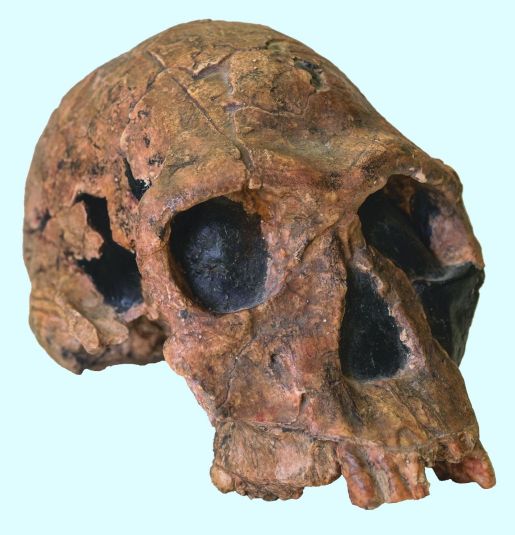
Der Schädel KNM-ER 1813 (Abguss) von „Homo“ habilis. (Foto: Thomas Küchler)
Neues Teilskelett im Kontext bisheriger Befunde
Zusammenfassung
Im Jahr 1964 wurde die Art Homo habilis in die Paläoanthropologie eingeführt. Die Zuordnung zur Gattung Homo war von Anfang an umstritten, setzte sich aber in der Folgezeit durch. Aufgrund zahlreicher menschenaffenähnlicher Merkmale schlugen Wood & Collard (1999) vor, die Art aus der menschlichen Gattung auszugliedern und zur Gattung Australopithecus zu stellen. Die Fachwelt folgte diesem Vorschlag allerdings nicht.
Im Jahr 2026 wurde ein neues Teilskelett von „Homo“ habilis beschrieben. Der Neufund KNM-ER 64061 ist von allen vier bisher bekannten „Homo“-habilis-Teilskeletten am vollständigsten erhalten.
Die Gliedmaßen von KNM-ER 64061 sind denen von OH 62 und KNM-ER 3735 sehr ähnlich, während das Postcranium (Körperskelett) von OH 7 nur Handknochen umfasst.
„Homo“ habilis zeichnet sich durch menschenaffenähnliche Körperproportionen aus: lange Unterarme im Verhältnis zu den Oberarmen sowie lange obere Gliedmaßen im Verhältnis zu den unteren. In diesen Merkmalen ist „Homo“ habilis noch menschenaffenähnlicher als Australopithecus afarensis. Homo erectus zeigt dagegen modern-menschliche Körperproportionen. Die Knochen der oberen Extremitäten von „Homo“ habilis besitzen zudem eine hohe Biege- und Torsionsfestigkeit, ähnlich der von Australopithecinen und modernen Menschenaffen, und sie sind deutlich verschieden von Homo erectus und dem modernen Menschen.
Die menschenaffenähnlichen Körperproportionen, die hohe Knochenfestigkeit sowie die gekrümmten Fingerglieder sind starke Hinweise auf ein gewohnheitsmäßiges Klettern (arborikole Fortbewegung) von „Homo“ habilis. Abgesehen von den Fingergliedern besitzt „Homo“ habilis auch an den übrigen postcranialen Knochen nichtmenschliche Merkmale.
Weitere nichtmenschliche Merkmale von „Homo“ habilis betreffen den Kauapparat, die Innenohrmorphologie und die rekonstruierte Kindheitsdauer. Auch die Nahrungszusammensetzung, die der der Australopithecinen ähnelt, sowie die Tatsache, dass „Homo“ habilis kein Jäger, sondern vielmehr Beute von Raubtieren war, sprechen gegen eine Einordnung als menschliches Wesen. Das geschätzte Körpergewicht von „Homo“ habilis, das unter dem des Menschen und im Bereich der Australopithecinen liegt, steht mit diesen Befunden im Einklang.
Die Befunde am neu entdeckten Teilskelett KNM-ER 64061 bestätigen die überfällige taxonomische Revision von „Homo“ habilis. Diese Spezies ist aus der Gattung Homo auszuschließen und könnte stattdessen am ehesten zur Gattung Australopithecus gestellt werden.
Trotz seit langem geäußerter Kritik wird seit Jahrzehnten „Homo“ habilis als phylogenetisch (stammesgeschichtlich) vermittelnde Fossilgruppe zwischen den Australopithecinen und dem frühesten echten Menschen (Homo erectus) dargestellt.
Die bis heute anhaltende Verweigerung der überfälligen taxonomischen Revision durch die Wissenschaftsgemeinschaft hat einen plausiblen Grund: Mit der Rückstufung des menschenaffenähnlichen „Homo“ habilis wird die morphologische Lücke zwischen den Australopithecinen und dem echten Menschen (Homo erectus und spätere Formen) deutlicher sichtbar. Es würde zu offenkundig werden, dass ein zeitlich und morphologisch passendes Bindeglied fehlt, das evolutionär zwischen den klar abgrenzbaren Gruppen der großaffenartigen Australopithecinen einerseits und den echten frühen Menschen (Homo erectus und spätere Homo-Arten) andererseits vermitteln könnte.
Summary (via DeepL)
In 1964, the species Homo habilis was introduced into paleoanthropology. Its classification within the genus Homo was controversial from the outset but eventually gained acceptance. Due to numerous characteristics similar to those of great apes, Wood & Collard (1999) proposed removing the species from the human genus and placing it in the genus Australopithecus. However, the scientific community did not follow this proposal.
In 2026, a new partial skeleton of “Homo” habilis was described. The new find, KNM-ER 64061, is the most complete of all four known “Homo” habilis partial skeletons to date.
The limbs of KNM-ER 64061 are very similar to those of OH 62 and KNM-ER 3735, while the postcranium (body skeleton) of OH 7 consists only of hand bones.
“Homo” habilis is characterized by great ape-like body proportions: long forearms in relation to the upper arms, and long upper limbs in relation to the lower limbs. In these characteristics, “Homo” habilis is even more great ape-like than Australopithecus afarensis. Homo erectus, by contrast, exhibits modern-human body proportions. The bones of the upper extremities of “Homo” habilis also possess high flexural and torsional strength, similar to that of australopithecines and modern great apes, and they are distinctly different from those of Homo erectus and modern humans.
The great-ape-like body proportions, high bone strength, and curved finger phalanges are strong indications of habitual climbing (arboreal locomotion) in “Homo” habilis. Aside from the finger phalanges, “Homo” habilis also exhibits non-human characteristics in its other postcranial bones.
Other non-human characteristics of “Homo” habilis include the masticatory apparatus, inner ear morphology, and the reconstructed duration of childhood. The dietary composition, which resembles that of the australopithecines, as well as the fact that “Homo” habilis was not a hunter but rather prey to predators, argue against classifying it as a human species. The estimated body weight of “Homo” habilis, which is lower than that of humans and within the range of australopithecines, is consistent with these findings.
The findings from the newly discovered partial skeleton KNM-ER 64061 confirm the long-overdue taxonomic revision of “Homo” habilis. This species should be excluded from the genus Homo and could instead most likely be placed in the genus Australopithecus.
Despite long-standing criticism, “Homo” habilis has been portrayed for decades as a phylogenetic (evolutionary) transitional fossil group between the australopithecines and the earliest true humans (Homo erectus).
The scientific community’s continued refusal to carry out this long-overdue taxonomic revision has a plausible reason: Downgrading the great-ape-like “Homo” habilis would make the morphological gap between the australopithecines and true humans (Homo erectus and later forms) more clearly visible. It would become too obvious that a chronologically and morphologically appropriate transitional form is missing—one that could bridge the evolutionary gap between the clearly distinguishable groups of the great-ape-like Australopithecines on the one hand and the true early humans (Homo erectus and later Homo species) on the other.
Inhalt
1. Einleitung
2. Die „Homo“-habilis-Teilskelette
3. Körperverhältnisse des neuen Teilskeletts KNM-ER 64061
3.1 Längenverhältnis von Unterarm zu Oberarm
3.2 Längenverhältnis von Arm zu Bein
3.3 Mechanische Belastbarkeit der oberen Extremität
3.4 Widerstand gegen Torsion
3.5 Widerstand gegen Biegung
3.6 Resümee
4. Körperbau von „Homo“ habilis ähnelt Australopithecinen
4.1 Körperproportionen
4.2 Mechanische Stabilität der Arme
4.3 Körpergewicht
4.4 Spezifische Knochenmerkmale
4.5 Resümee